St. Augustine Grass Pest Problems: Chinch Bugs, Sod Webworms & More
Something is wrong with your lawn. You can see it — a patch of yellow or brown turf that was not there last week. You run the sprinklers. You wait. Nothing improves. The patch gets bigger.
This is one of the most common and frustrating problems St. Augustine homeowners deal with, and it is made worse by the fact that the most common causes of lawn damage in this area look nearly identical to each other at first glance. Chinch bug infestations, drought stress, sod webworm feeding, and fungal disease can all produce brown or yellow patches on Floratam grass. The fixes for each are different. Treating the wrong cause does not just waste money — it can make some problems worse while the actual cause continues unchecked.
This guide covers the most common reasons St. Augustinegrass declines in the St. Augustine and St. Johns County area, what each problem actually looks like on the ground, how to tell them apart, and when it makes sense to bring in a professional evaluation. The goal is to help you understand what you are actually seeing before you do anything else.
Why St. Augustine Grass Damage Is Easy to Misdiagnose
St. Augustinegrass (Stenotaphrum secundatum) is the most widely used lawn grass in Florida. It covers the vast majority of residential lawns across St. Johns County and is the default choice when new sod is laid in neighborhoods like Nocatee, Palencia, and World Golf Village. The most common variety in this area is Floratam, though Palmetto is also present, particularly in older neighborhoods or yards with more shade.
The challenge is that Floratam looks the same whether it is being eaten by insects, starved of water, attacked by fungus, or cut too low by a mower. The blades turn yellow. Then they turn brown. Then they die.
Because the visual symptoms overlap so heavily, many homeowners end up treating the wrong problem. They water more when they should be looking for insects. They apply fertilizer when the issue is fungal disease. They call for a pest treatment when the lawn simply needs better irrigation coverage.
Getting the diagnosis right matters. Read the lawn before you react.
The Most Common Misread: Chinch Bug Damage vs. Drought Stress
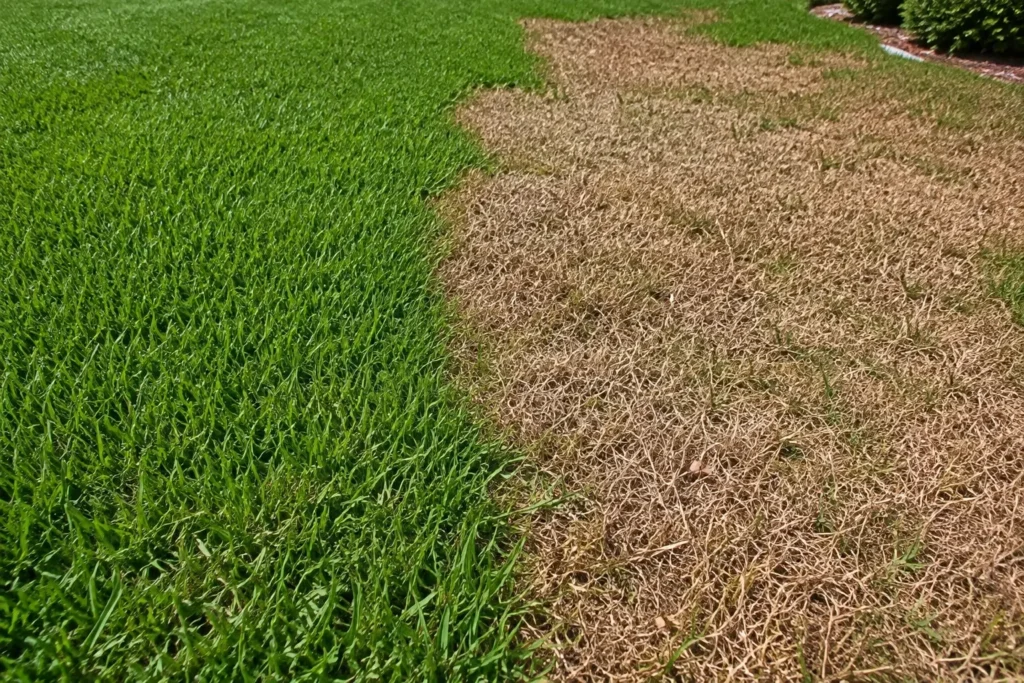
The single most common misdiagnosis in St. Augustine and the broader St. Johns County area is treating chinch bug damage as drought stress. It happens because both problems produce a similar visual result: yellow patches of lawn that eventually go brown.
The University of Florida Institute of Food and Agricultural Sciences (UF/IFAS) identifies the southern chinch bug (Blissus insularis) as the most damaging insect pest of St. Augustinegrass in the United States. Despite that well-documented status, chinch bugs are regularly confused with irrigation problems at the homeowner level — often until significant turf loss has already occurred.
The practical distinction matters because the two problems behave differently over time. Drought-stressed grass typically responds to adequate irrigation within a day or two, beginning to recover as moisture reaches the roots. Grass that has been damaged by actively feeding chinch bugs does not respond the same way, because the insects continue feeding regardless of how much water is applied. The damage keeps spreading while the irrigation runs.
How to Read the Damage Pattern Before You Treat Anything
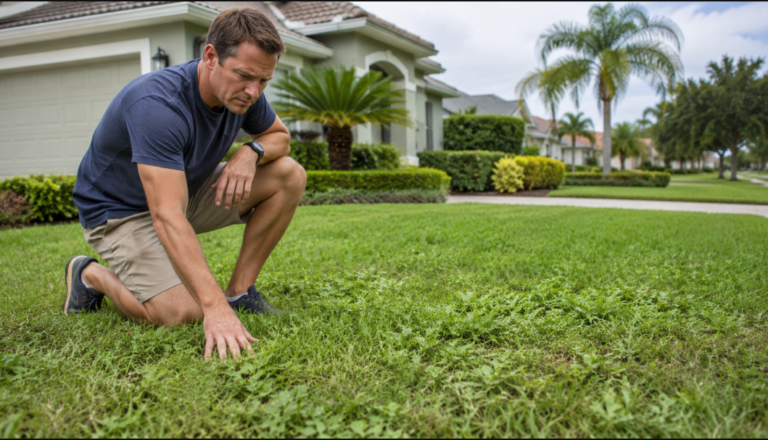
Before you adjust your sprinkler schedule, pull out a pesticide, or call anyone, spend five minutes walking the damaged area of your lawn. Where the damage appears, how it is shaped, and what the affected grass looks like up close will tell you more than any general rule.
Where on the Lawn Did the Damage Appear?
Location is one of the most useful clues you have.
Sunny edges near hard surfaces. Damage that begins at the border of a driveway, sidewalk, or fence line — in a part of the lawn that receives full sun — is a pattern associated with chinch bugs. UF/IFAS research notes that the southern chinch bug thrives during warm, dry summer conditions. The turf near a concrete driveway or south-facing sidewalk is exactly the kind of environment they prefer.
Damage that does not follow your sprinkler zones. If you look at where your irrigation heads reach and the damaged patch does not line up with a coverage gap, drought stress becomes less likely as the primary explanation. Drought stress tends to appear where water coverage is weakest: near slopes, sandy pockets, or zones where heads may have poor overlap.
Widespread damage or damage in shaded areas. Diffuse yellowing that appears across a larger area, or yellowing in parts of the lawn that receive shade, is more likely to be a nutrient deficiency, disease issue, or irrigation problem than an insect infestation.
What Does the Damaged Turf Look Like Up Close?
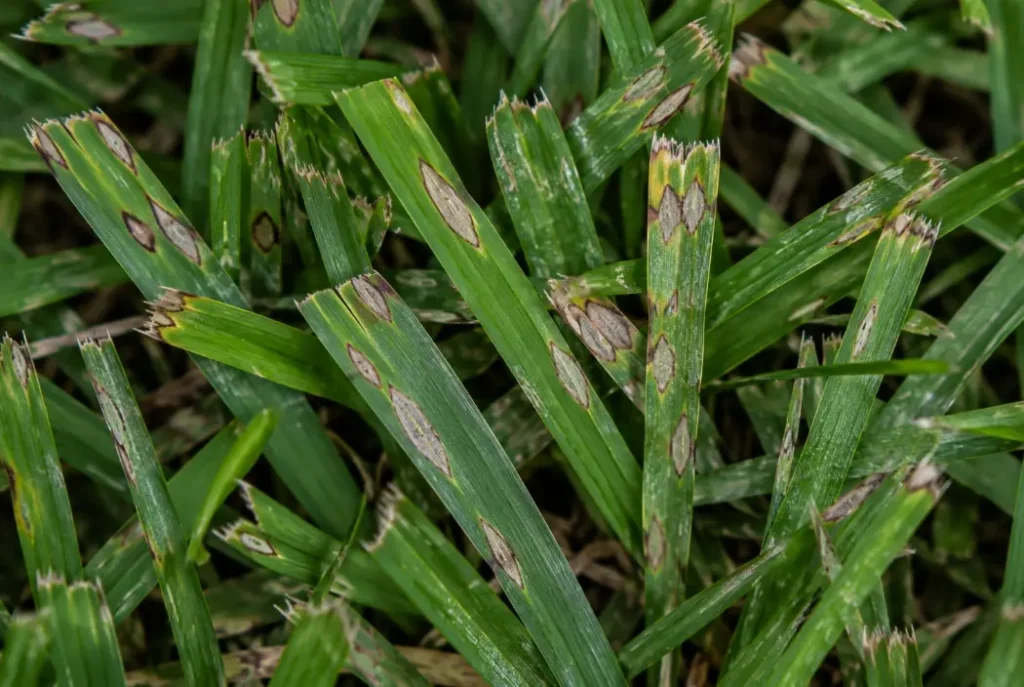
Get down to ground level and look at individual grass blades in the yellowing zone — not the dead center of the damage.
Yellowed blades with no visible spotting. Common in both chinch bug damage and drought stress. Not enough information on its own.
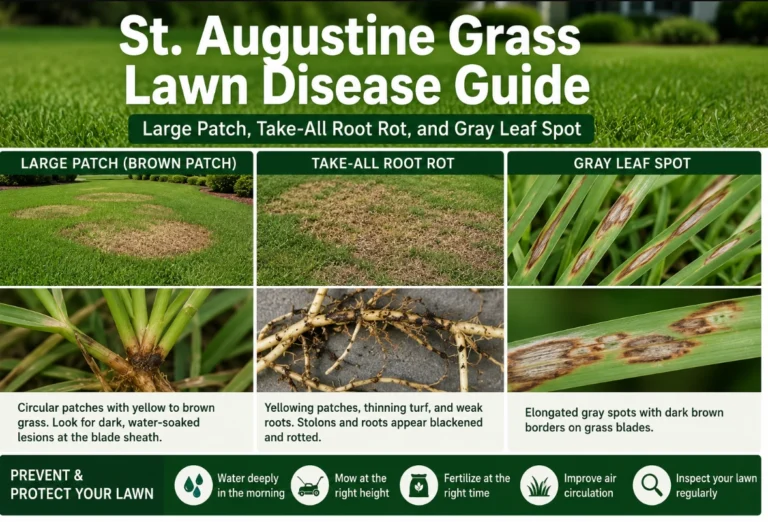
Blades with distinct tan or brown oblong spots. The blade itself has small lesions with a grayish center and a darker brown border. This pattern points toward gray leaf spot, a fungal disease common during warm, rainy periods in Florida. The spots are diagnostic — they do not appear with insect damage or drought.
Blades that look notched or chewed along the edges. UF/IFAS Extension describes notched grass blade edges as a characteristic sign of sod webworm feeding on St. Augustinegrass.
Blades that appear ragged and shorter than surrounding grass. An early sign of sod webworm activity — the caterpillars consume the blades, creating an unevenly cut appearance.
How Fast Did the Damage Spread?
Pest damage from actively feeding insects tends to spread. A chinch bug patch the size of a garbage can lid this week may be considerably larger next week. The expansion follows the insects, which feed at the advancing edge of the damage and move outward.
Drought stress also expands if irrigation is not corrected, but it tends to follow irrigation patterns — zone edges, sprinkler radii, dry spots. Fungal disease can spread quickly under warm, wet conditions, but the pattern of spread differs from insect damage.
Chinch Bugs in St. Augustine Grass
The southern chinch bug (Blissus insularis) is the pest St. Augustine homeowners are most likely to deal with, and the most important one to identify correctly. According to UF/IFAS, this insect is the most damaging insect pest of St. Augustinegrass in the United States, and chinch bugs cost Florida homeowners and professionals millions of dollars annually.
Floratam, the variety that covers most residential lawns in St. Johns County, was originally developed with chinch bug resistance. According to UF/IFAS, that resistance has largely been lost over time, and chinch bugs are now a major pest of Floratam. Palmetto St. Augustinegrass is not resistant to insects either, per UF/IFAS.
What Chinch Bug Damage Looks Like
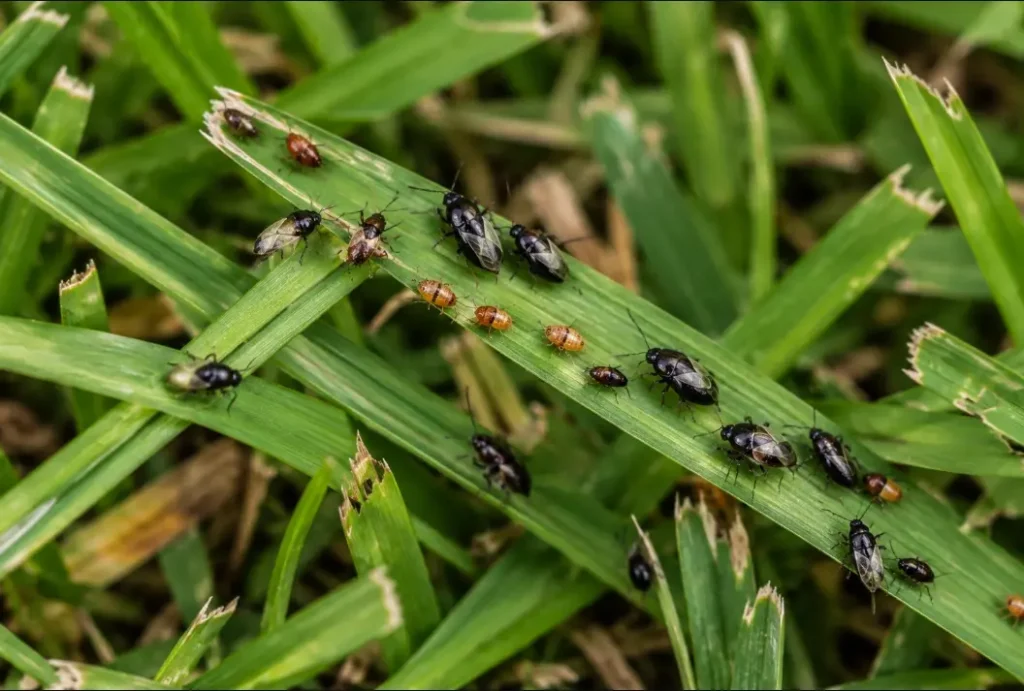
Chinch bugs are small — adults are roughly one-fifth of an inch long, with a black body and white wings that have a small black triangular marking. Nymphs are smaller and range from reddish-orange with a white band to dark gray as they mature. You are unlikely to see them easily from a standing position.
The damage they cause is more visible than the insects themselves. Chinch bugs use piercing mouthparts to feed on grass sap and disrupt the blade’s ability to function. The result is the characteristic yellow-to-brown expanding patch, starting where conditions are hottest and driest. You will typically see a zone of yellowing grass at the active edge of the damage, with dead brown turf at the center of older damage where the insects have already moved on.
When Chinch Bug Pressure Peaks in St. Johns County
UF/IFAS research indicates that chinch bug infestations in Florida peak in early July. In the St. Augustine area, the practical window of highest risk runs from late June through August, when summer temperatures are highest and turf stress is greatest.
UF/IFAS also notes that the southern chinch bug does not need to leave its feeding area and typically remains sheltered around the roots and base of St. Augustinegrass even in North Florida. Spring infestations often begin where pest damage stopped the previous season.
If you are managing a lawn in Palencia, World Golf Village, or St. Augustine Beach and you see yellowing near a sun-exposed concrete edge in July or August, chinch bugs are one of the first things worth ruling in or out.
How to Confirm a Chinch Bug Infestation
You do not need any special equipment to check for chinch bugs. UF/IFAS Extension describes a flotation scouting method that homeowners can perform themselves.
Remove both ends from a large coffee can or use a section of wide PVC pipe. Push it two to three inches into the soil at the edge of the damaged area — where yellowing grass meets still-green turf. This is where the active insects are; they have already moved on from the dead center. Fill the can with water and keep it topped up for five minutes. Watch the surface. If chinch bugs are present, you will see small dark adults or reddish-orange nymphs float to the surface.
Sampling the dead center of the damage is not productive. Look for the living edge where green meets yellow.
What Does Chinch Bug Damage Look Like on St. Augustine Grass?
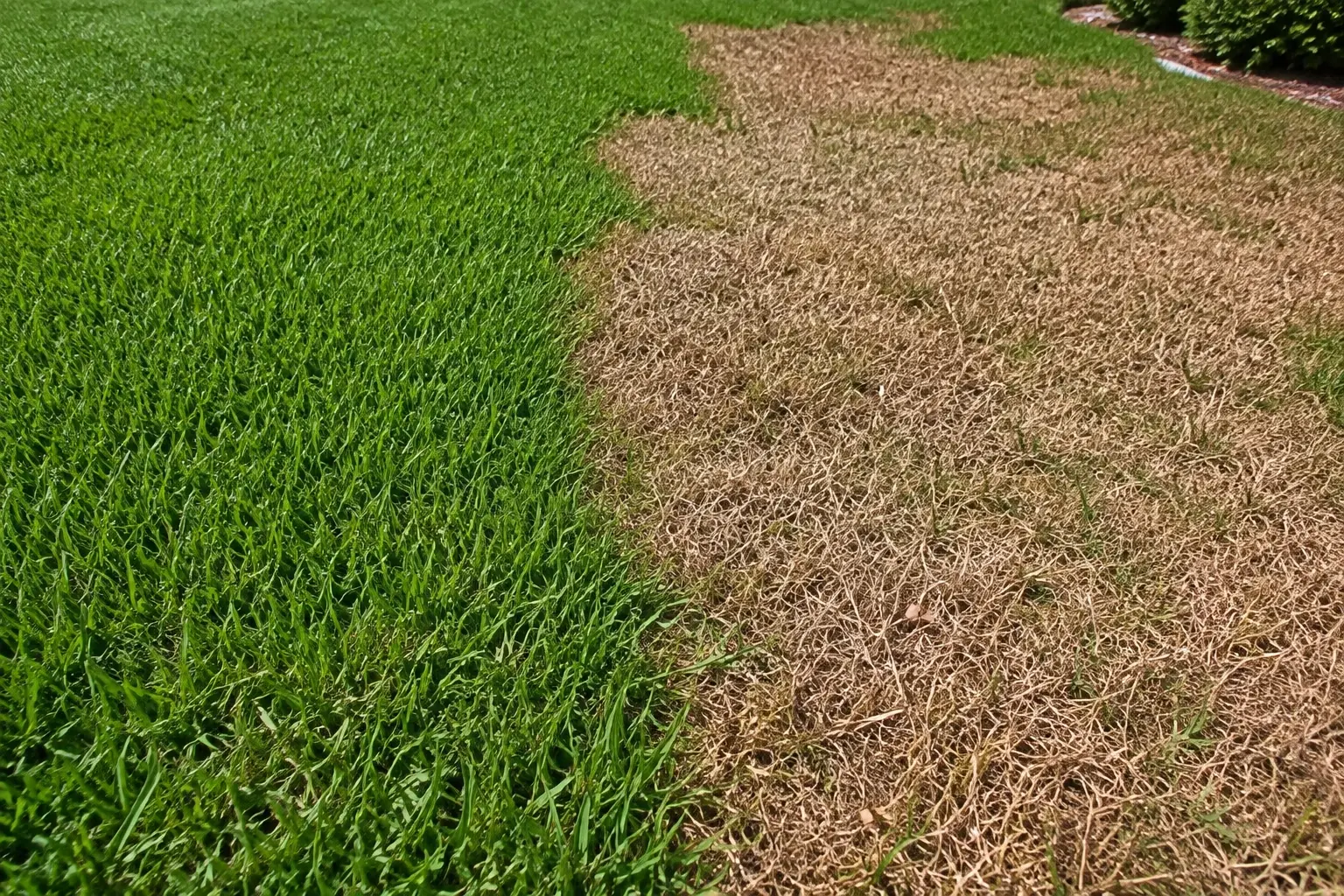
Irregular yellow-to-brown patches in the sunniest, hottest part of the lawn — often starting near a driveway, sidewalk, or south-facing border. The damage spreads outward. The center of older damage is typically dead brown, while the active edge shows yellowing. The patches do not recover after irrigation if chinch bugs are actively feeding. Confirming with a flotation test before treating is the recommended approach.
Sod Webworms — The Pest Most St. Augustine Homeowners Don’t Recognize
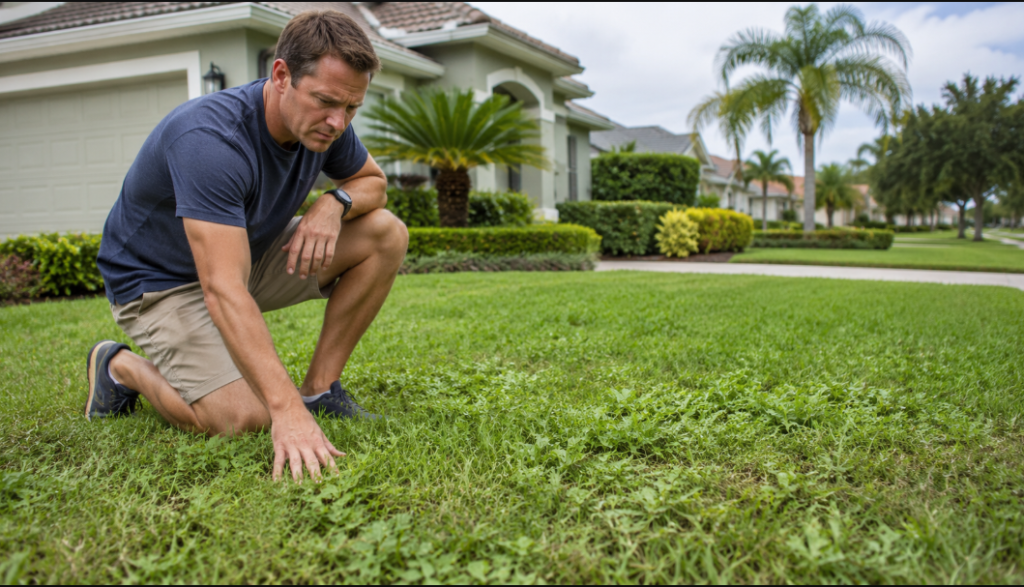
Tropical sod webworms (Herpetogramma phaeopteralis) are a common and often overlooked pest of St. Augustinegrass and other warm-season turfgrasses in Florida. According to UF/IFAS, they are destructive pests on lawns, newly established sod, and turf areas across the southeastern United States.
Many homeowners never see the larvae themselves because sod webworms feed at night and hide in the thatch layer during the day. What you notice is the result of their feeding, not the insects.
What Sod Webworm Damage Looks Like
UF/IFAS Extension describes the first sign of sod webworm activity as often being a difference in grass height — areas where larvae are feeding appear shorter or unevenly cut compared to surrounding turf, because the caterpillars are consuming the grass blades.
On St. Augustinegrass specifically, UF/IFAS Extension describes notched areas along the edges of grass blades as a characteristic indicator of sod webworm chewing damage. If the edges of the blades in an affected area appear bitten or notched rather than simply yellowed or spotted, sod webworms are worth investigating further.
The larvae themselves are light yellow to orange with brown spots on each body segment. They are found in the thatch layer during the day. One field scouting technique is a soap drench: mix a small amount of dish soap with water and pour it over a square foot of affected turf. Sod webworm larvae will typically come to the surface within a few minutes.
How to Tell Sod Webworms From Chinch Bug Damage
The key visual difference is at the blade level. Chinch bug damage produces overall yellowing across the whole blade as a result of sap feeding. Sod webworm damage produces notched or chewed blade edges — the blade has been partially consumed.
Sod webworm damage also tends to look ragged or uneven before it produces clearly defined dead patches, which is more typical of heavy chinch bug infestations.
Fall Armyworms — Fast, Widespread, and Easy to Misread
Fall armyworms (Spodoptera frugiperda) are caterpillars, not sap feeders, and are part of what UF/IFAS describes as a pest complex of warm-season turf caterpillars in Florida alongside tropical sod webworms.
What Armyworm Damage Looks Like vs. Chinch Bug Damage
The most significant difference between armyworm damage and chinch bug damage is the speed and scale. Armyworms feed in large numbers and can consume large areas of turf rapidly — a lawn can look fine on Friday and show significant damage by Monday. Like sod webworms, armyworm damage produces a chewed or consumed appearance rather than simple yellowing. The grass blades are being physically eaten, not yellowed by sap feeding.
When Armyworms Typically Hit St. Augustine Lawns
UF/IFAS Extension notes that fall armyworms are “also active when the weather turns cooler” — they are a concern from late summer into fall. In the St. Johns County area, the most important window is August and September.
If you see fast-moving, large-area damage appearing in late summer or fall — and the grass blades look consumed rather than simply yellowed — armyworms are worth considering alongside chinch bugs.
When the Problem Is Not a Pest — Four Causes That Look Like Pest Damage
Not every brown patch in a St. Augustine lawn is caused by an insect. Several non-pest problems produce damage that looks almost identical to pest infestations, and treating for pests when the actual cause is something else wastes time and money.
Drought Stress — What It Looks Like and How to Rule It In or Out
Drought stress in St. Augustinegrass produces yellowing and browning that can look similar to chinch bug damage. The key distinctions are in the pattern and the response to irrigation.
Drought stress tends to follow the logic of your irrigation system — dry patches appear where sprinkler coverage is weakest, near slopes, sandy pockets, zone edges, or spots where heads may not reach well.
Drought-stressed grass also recovers. If you water adequately and the grass begins to show improvement within a day or two, drought stress is the more likely cause. If you water and nothing changes — or the area continues to expand — something else is happening.
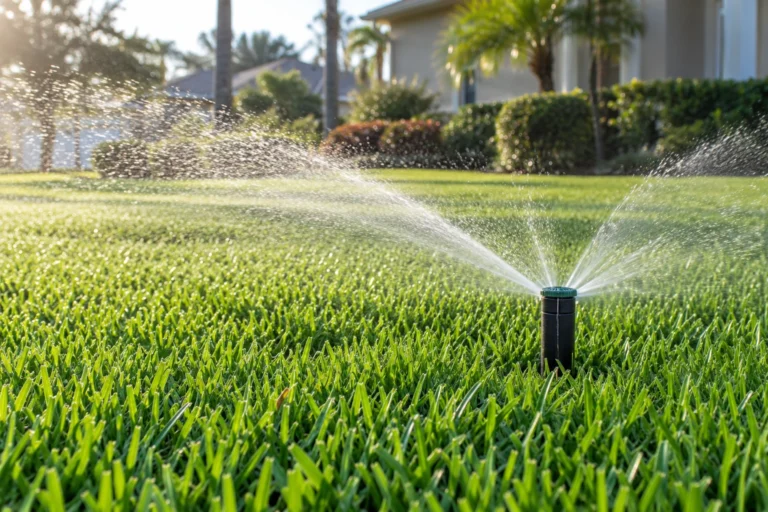
To check irrigation coverage, run each zone and watch where the water actually lands. Coverage gaps are often obvious when you look carefully.
Gray Leaf Spot Fungal Disease — A Common Misdiagnosis in Summer
Gray leaf spot is a fungal disease caused by Pyricularia grisea that specifically affects St. Augustinegrass in Florida — UF/IFAS states it is the only warm-season turfgrass affected by this disease in the state.
UF/IFAS describes the diagnostic symptom as an oblong leaf spot with a center that may develop a gray, felt-like appearance during extended warm moist conditions. The spot border is typically dark brown. Rapidly expanding lesions may have an olive green, water-soaked edge. When the disease is severe, the stand appears thin and unthrifty, with multiple spots coalescing to turn entire blades or shoots brown.
Gray leaf spot favors warm rainy periods from May through September, per UF/IFAS. Overwatering or irrigating in the evening — which extends the period of leaf wetness — creates favorable conditions for the disease.
The key distinction from pest damage: inspect individual grass blades. Gray leaf spot produces visible oblong spots on the blades themselves. Chinch bug damage and drought stress do not.
Fertilizer Deficiency or Burn — What That Looks Like
Both too little and too much fertilizer can cause a St. Augustine lawn to yellow or decline. Nitrogen deficiency typically produces a general, relatively uniform light green to yellow color across the lawn rather than the patchy, localized damage of an insect infestation. UF/IFAS notes that both nitrogen and iron deficiency produce yellowing, but they are different — applying iron does not address nitrogen deficiency.
Fertilizer burn from excessive or misapplied product produces streaked or patchy brown areas that often follow the application pattern — you may see stripes or rows corresponding to how the spreader was run.
If the yellowing is widespread and relatively uniform across the lawn rather than concentrated in a specific zone, a fertility issue may be worth considering before looking for insects.
Scalping Damage — When the Problem Is the Mower
Cutting St. Augustinegrass too short removes enough of the blade that the crowns are exposed and the lawn cannot recover normally. This produces dead-looking patches that can be confused with other causes.
UF/IFAS states that Floratam should be mowed to a height of 3.5 to 4 inches and Palmetto to 3 to 4 inches. Cutting below the recommended height in hot summer conditions exposes the grass crown to direct sunlight and heat.
Scalping damage tends to appear after a mowing and follows the pattern of where the mower traveled. It does not spread over time the way insect damage does. If you are looking for more detail on mowing height and its effect on turf health, our lawn mowing page covers recommended practices for St. Augustine grass in this area.
How St. Augustine Homeowners Can Check Their Own Lawn
Before reaching any conclusions, a structured observation of the damaged area gives you the most useful information.
Step 1: Find the exact boundary of the damage. Walk the perimeter of the affected area. Where does healthy grass become yellow? Where does yellow become brown? The active edge of the damage tells you more than the dead center.
Step 2: Check the location. Is it in full sun near a hard surface? More consistent with chinch bugs. Is it following a zone edge or sprinkler gap? More consistent with drought stress.
Step 3: Get down to the blade level. Look at individual grass blades in the yellow zone. Are the blades simply yellowed? Are there distinct spots on the blade surface? Are the edges notched or chewed?
Step 4: Check the soil moisture. Push a screwdriver into the soil in the damaged area. If it goes in easily, the soil is moist. If it resists, the area may be dry. Dry soil in a damaged area suggests drought is a contributing factor; moist soil with ongoing damage suggests insects or disease.
Step 5: If chinch bugs are suspected, perform the flotation test. Coffee can, pushed into the soil at the active edge, filled with water, observed for five minutes. Sample where yellow meets green, not the dead center.
Step 6: Note the timing. Damage during a prolonged wet period? Consider fungal disease. Appeared suddenly after mowing? Consider scalping. Expanding slowly during peak summer heat? Consider chinch bugs.
Is Gray Leaf Spot a Fungus or a Pest?
Gray leaf spot is a fungal disease, not an insect pest. It is caused by Pyricularia grisea and affects St. Augustinegrass during warm, rainy periods from May through September. It produces visible oblong spots with grayish or tan centers and dark brown borders on individual grass blades. Insect pests cause general yellowing or blade chewing without the characteristic individual blade lesions that gray leaf spot produces.
When to Keep Watching and When to Get Professional Help
Not every lawn problem requires a professional evaluation, and not every problem needs immediate action.
Signs You Can Monitor on Your Own
A single small yellowing patch that appeared during a dry period and has not changed size in a week or more is often worth monitoring before treating. If the patch responds to improved irrigation, you have your answer.
Damage that appears after a mowing and does not spread is more likely to be a mowing-related issue than an infestation.
General, uniform yellowing across the whole lawn after an extended dry period suggests drought stress — address irrigation before anything else.
Signs the Problem Needs Professional Evaluation
The damage is spreading. A patch that is actively growing larger — particularly during the June-to-September window — should be evaluated sooner rather than later. Chinch bug populations that go unaddressed continue feeding, and the cost of turf replacement grows with each week of delay.
You have done the flotation test and are not certain what you found. A professional who knows St. Augustinegrass and the specific pest pressure in St. Johns County can confirm the diagnosis and recommend the right treatment.
You are in an HOA community with inspection deadlines. If your lawn in Nocatee, World Golf Village, or Palencia is approaching an inspection date, professional diagnosis is more useful than guessing and treating.
You are managing a property remotely. If you are looking at photos sent by a property manager for a rental on Anastasia Island or St. Augustine Beach, a professional who can physically inspect the turf will give you information that photographs alone cannot always provide.
The damage is severe. If 25% or more of the lawn is visibly damaged, prompt diagnosis and treatment is more practical than waiting.
If you are in the St. Augustine or St. Johns County area and would like a same-day evaluation, St. Augustine Lawn Care Pros is available to assess what you are seeing and identify the cause before you spend money on the wrong fix.
Frequently Asked Questions About St. Augustine Grass Pest Damage
What does chinch bug damage look like on St. Augustine grass?
Irregular yellow-to-brown patches in the sunniest, hottest part of the lawn — often starting near a driveway edge, sidewalk, or south-facing turf border. The center of older damage is dead brown, while the active outer edge shows yellowing. The patches do not recover after watering the way drought-stressed grass does.
How do I tell chinch bug damage from drought stress?
Both cause yellowing and browning, but the patterns differ. Drought stress tends to follow irrigation coverage gaps — zone edges, slopes, sandy pockets, or spots where sprinkler heads do not reach well. Chinch bug damage tends to start in full-sun areas near hard surfaces and spread outward regardless of irrigation. Drought-stressed grass also responds within a day or two to adequate watering; chinch bug-damaged grass does not recover the same way. The flotation test described above can confirm whether chinch bugs are present.
What are the tiny bugs in my St. Augustine grass?
The most likely candidates are southern chinch bugs. Adult chinch bugs are small — roughly one-fifth of an inch — with black bodies and white wings marked with a small black triangle. Nymphs are smaller and range from reddish-orange with a white band to dark gray as they mature. You can confirm their presence with the flotation scouting method.
What causes St. Augustine grass to die in patches?
Patches of dead or dying St. Augustinegrass are most commonly caused by chinch bug feeding, sod webworm or armyworm activity, drought stress, gray leaf spot fungal disease, mowing damage, or fertilizer problems. The cause matters because the response to each is different. Read the damage pattern and inspect the blades before treating.
Do chinch bugs come back every year in Florida?
Yes. UF/IFAS research notes that the southern chinch bug typically remains active sheltered around the roots and base of St. Augustinegrass even in North Florida, and that spring infestations often begin where pest pressure stopped the previous season.
When is chinch bug activity highest in St. Augustine?
According to UF/IFAS research, chinch bug infestations in Florida peak in early July. The highest-risk window for the St. Augustine and St. Johns County area runs from late June through August, when summer heat and drought conditions are most favorable for the pest.
What does sod webworm damage look like?
Sod webworm damage typically produces a ragged, uneven appearance in the turf — areas that look like they were cut shorter than surrounding grass. Up close, individual grass blades may show notched or chewed edges, which is characteristic of the caterpillar’s feeding method. The larvae are found in the thatch layer during the day and feed at night.
Is gray leaf spot a fungus or a pest?
Gray leaf spot is a fungal disease caused by Pyricularia grisea, not an insect pest. It affects St. Augustinegrass during warm, rainy periods from May through September and produces oblong spots on individual grass blades with grayish or tan centers and dark brown borders — a pattern that distinguishes it from insect damage or drought stress.
Can I diagnose chinch bugs myself?
Yes, with the flotation scouting method. Remove the ends of a large coffee can and push it two to three inches into the soil at the border of the damaged area — where yellowing grass meets healthy green turf. Fill the can with water and keep it topped off for five minutes. Chinch bugs will float to the surface if present. Sample the active edge of the damage, not the dead center.