St. Augustine Grass Lawn Disease Guide: Large Patch, Take-All Root Rot, and Gray Leaf Spot
Brown circles appearing on your Floratam lawn in October. A patch that yellows slowly through July’s rain. Spots you can see on individual grass blades up close. These three problems look related — but they are caused by different fungal diseases, they strike at different times of year, and the cultural fixes for each one are not the same.
This guide covers the three fungal diseases most likely to affect St. Augustinegrass in St. Johns County: large patch, take-all root rot, and gray leaf spot. If you are not yet sure whether your lawn problem is a disease or an insect pest, our guide to lawn pest problems in St. Augustine covers that distinction first, including how to confirm chinch bugs and sod webworms before treating for anything.
Why St. Augustine Grass Gets So Many Fungal Diseases
According to UF/IFAS, turfgrass diseases are the exception and not the rule for lawns — yellow or brown patches do not automatically mean disease. But St. Augustinegrass does deal with real fungal pressure, and the reasons are rooted in North Florida’s climate.
St. Johns County’s summers bring extended daily rainfall from June through September. Afternoon thunderstorms leave turf wet for hours. The combination of heat (80–90°F), high humidity, and leaf blades that stay wet overnight is close to ideal conditions for fungal infection. Sandy coastal soils add to the problem — they hold water in low spots while draining too quickly in others.
UF/IFAS is consistent on this: most fungal diseases in home lawns are triggered or worsened by management choices — irrigation timing, nitrogen, mowing height, and herbicide use. The pathogens are often already present in the soil or thatch. They become destructive when the grass is stressed or when conditions tip in their favor.
Large Patch (Brown Patch) — What It Is, When It Strikes, and What It Looks Like
Large patch is caused by the soil-borne fungus Rhizoctonia solani. You may also see it called brown patch — the two names refer to the same pathogen. “Large patch” is now the preferred term for warm-season turfgrasses.
When It Strikes
Large patch does not behave like most Florida lawn problems. It is active when temperatures drop, not when they rise. The fungus becomes active when nighttime temperatures fall below 80°F and is most aggressive in the 60–73°F range — what UF/IFAS identifies as optimal for R. solani in warm-season turf. In St. Johns County, that window typically arrives in October and November and can return in February and March.
Summer heat actually suppresses the pathogen. A lawn that shows large patch damage in fall may have had the fungus present all summer without any symptoms.
What It Looks Like
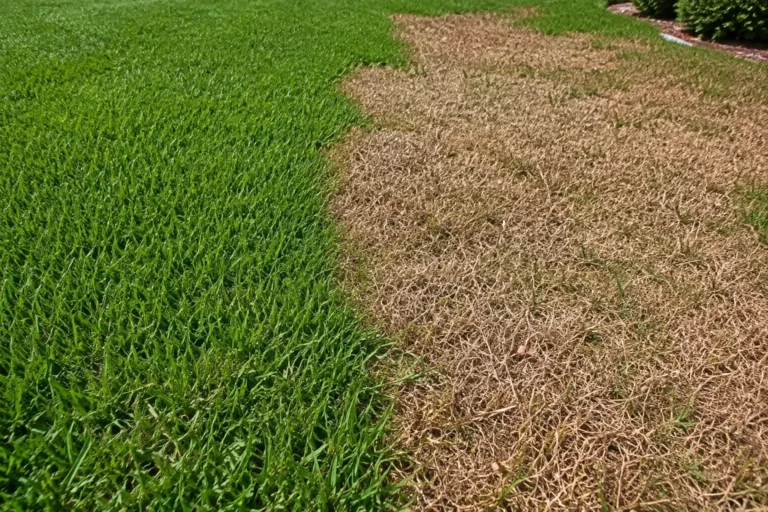
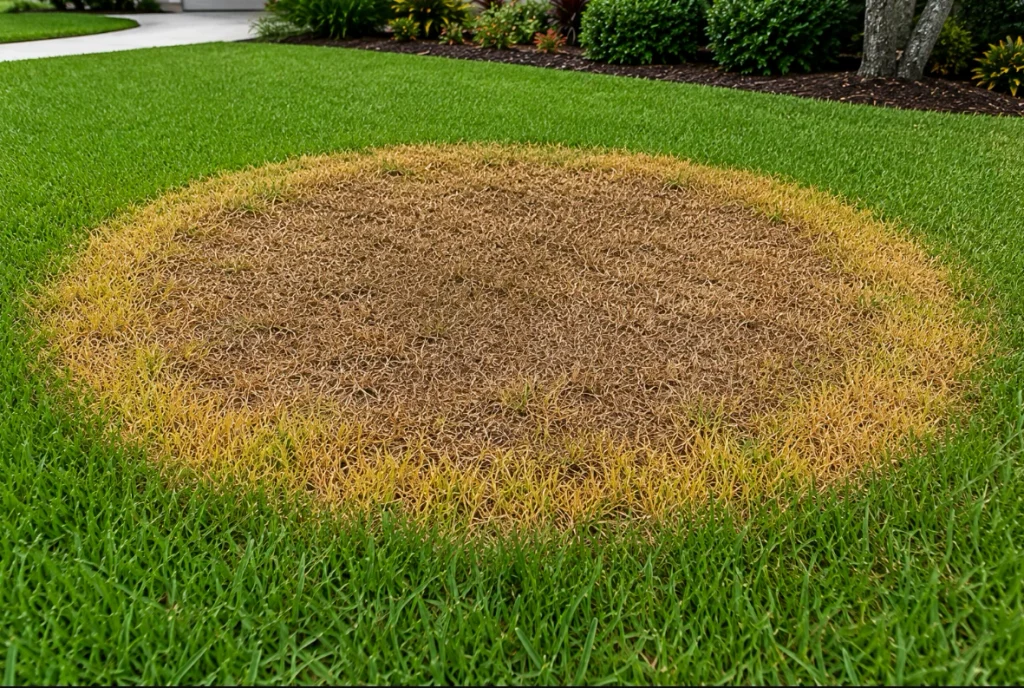
Large patch starts as roughly circular patches of discolored turf. UF/IFAS Extension (Collier County) describes the progression: affected areas begin as 6–12 inch off-color patches that turn yellow, then reddish-brown, then brown to straw-colored. Patches can expand to several feet in diameter and may merge. Rings of yellow or brown with green centers are common.
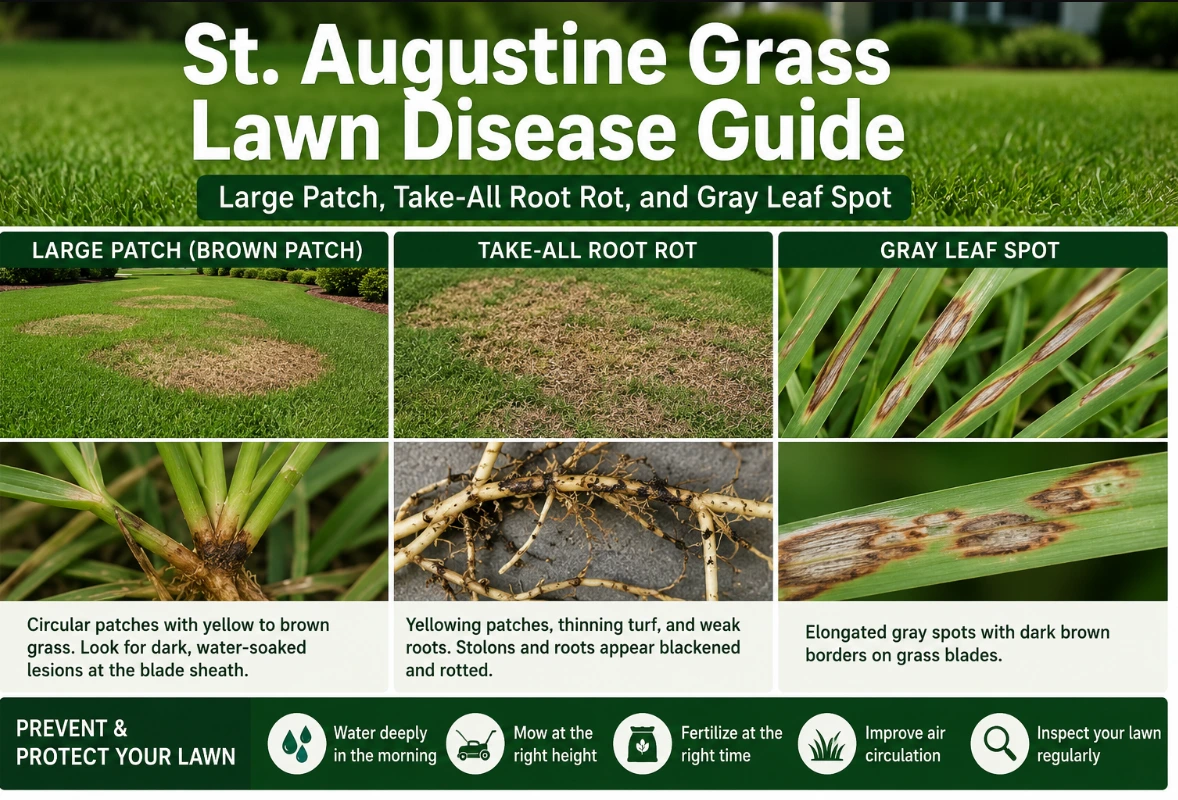
The diagnostic detail is at the base of the grass blade. Look at the sheath — the part of the blade where it meets the stolon. Large patch causes a dark, water-soaked rot at that junction. An infected blade pulls loose from the stolon with little resistance. That rot at the blade base is what distinguishes large patch from drought stress or mowing damage.
What Triggers It
Excessive nitrogen applied in late summer or early fall is the most common trigger. UF/IFAS notes that high nitrogen encourages lush, rapidly growing tissue — exactly what R. solani attacks most readily. Applying nitrogen after mid-September in North Florida creates the growth that becomes most vulnerable when temperatures drop.
Evening irrigation that keeps blades wet through cool nights is a secondary trigger.
Take-All Root Rot — The Underground Disease Most Homeowners Miss
Take-all root rot is caused by Gaeumannomyces graminis var. graminis. It is the most difficult of the three diseases to diagnose because the damage starts underground. UF/IFAS Extension Pinellas County has documented homeowners re-sodding the same area repeatedly because take-all root rot was never correctly identified — the lawn kept failing because the underlying disease was never addressed.
When It Strikes
Take-all root rot is most active during Florida’s summer rainy season — June through September in St. Johns County. Heavy, frequent rainfall, waterlogged soil, and a stressed root system create the conditions the pathogen exploits.
The critical timing issue: the roots are being destroyed weeks or months before leaves show visible symptoms. By the time you see yellowing, the disease has already been active below the surface. This is why the same patch keeps failing even after it appears to recover.
What It Looks Like
The first visible symptom is yellowing turf in irregular patterns — not the circular shape of large patch. The patches tend to follow drainage patterns or low spots in the lawn.
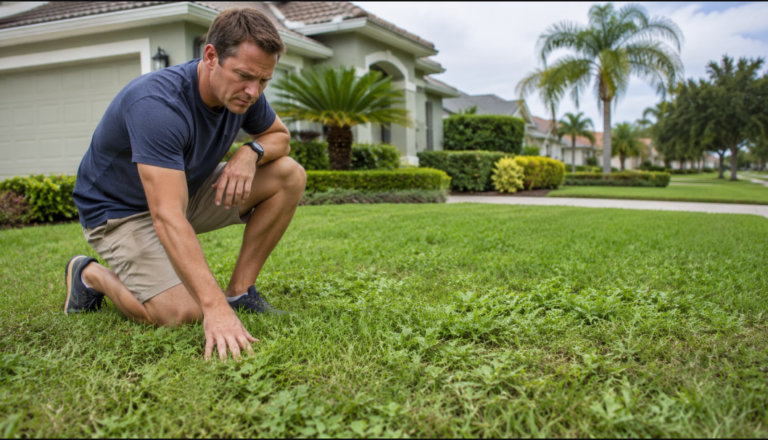
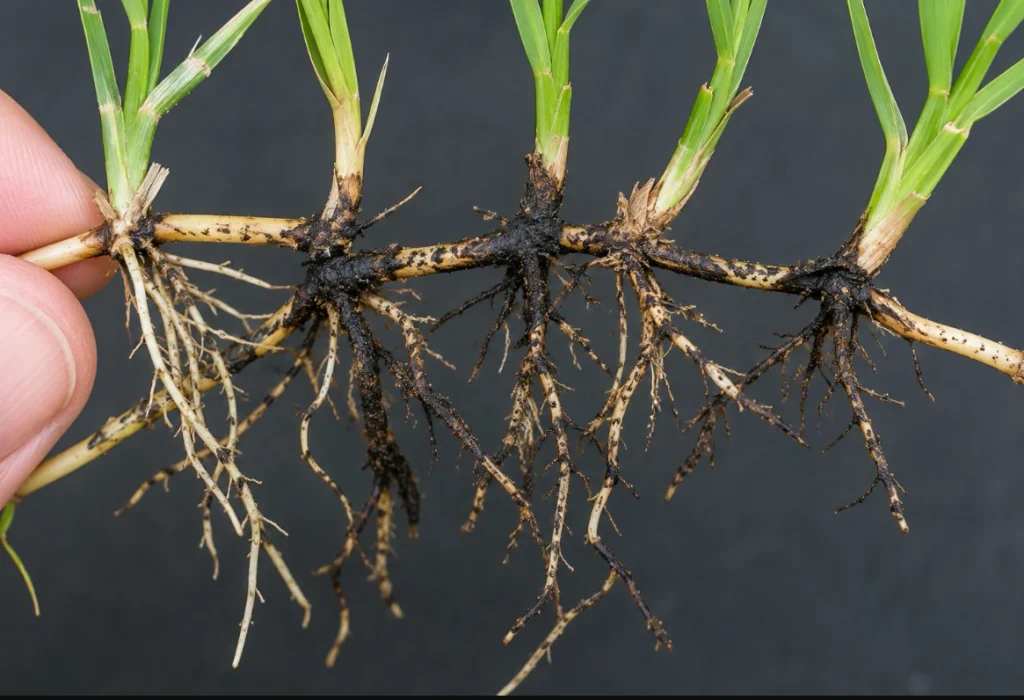
Confirmation requires pulling up a section of turf and examining the roots and stolons. Healthy St. Augustinegrass roots are white or light tan. Take-all root rot blackens the roots and stolon nodes. If the roots look dark and rotted while the lawn above is yellowing, take-all root rot is the most likely explanation.
Why It Keeps Coming Back
The pathogen persists in the soil. Re-sodding without addressing drainage, irrigation volume, pH, and turf stress typically produces the same result once the new sod establishes.
UF/IFAS is direct: there is no effective chemical control for take-all root rot once symptoms are visible. Preventive treatment before symptoms appear is the only chemical option. Once active, recovery is cultural — reducing stress and correcting the conditions that allowed the disease to take hold.
Gray Leaf Spot — Treatment and Prevention
Gray leaf spot is caused by Pyricularia grisea. It is the only one of these three diseases that directly targets the leaf blade. UF/IFAS states that in Florida, St. Augustinegrass is the only warm-season turfgrass affected by this disease.
When It Strikes
Gray leaf spot is a summer disease. According to UF/IFAS (PP126), warm rainy spells from May through September create extended periods of leaf wetness — 12 hours or more at 80–90°F — that the pathogen needs to spread. It develops quickly during Florida’s thunderstorm season when leaves stay wet overnight.
What It Looks Like
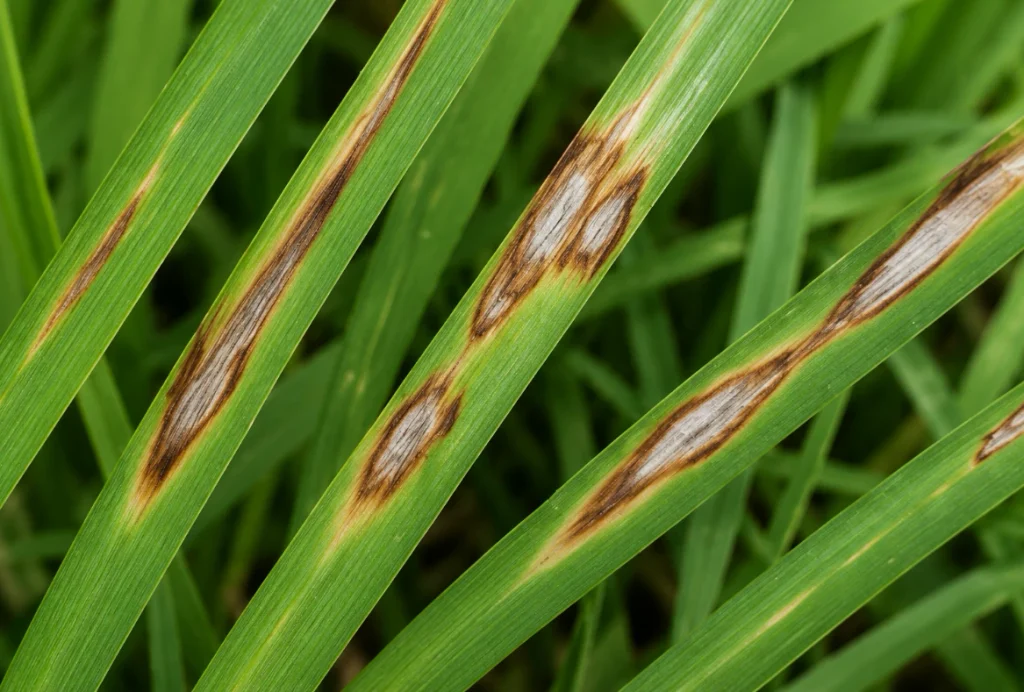
The diagnostic symptom is an oblong spot on the grass blade. Early spots appear olive green to brown with a dark brown border. In extended wet conditions, the center develops a gray, felt-like appearance as the fungus sporulates. Multiple spots on a blade coalesce and turn the whole blade brown. Across a large area, the lawn looks thin and generally unthrifty — similar to drought or nutrient deficiency from a distance.
The blade spotting is the key diagnostic feature. Gray leaf spot is the only disease of these three that produces visible lesions directly on the blade surface.
What Triggers It
Two management practices consistently appear in UF/IFAS research: excessive nitrogen and evening irrigation.
Excessive nitrogen creates rapid flushes of lush new growth that is significantly more susceptible to infection, per UF/IFAS. A high-nitrogen application during the rainy season can quickly create the tissue the pathogen exploits most readily.
Evening irrigation extends leaf wetness through the night. UF/IFAS recommends irrigating between 2 a.m. and 8 a.m., when dew is already present and turf dries quickly after sunrise.
Summer atrazine applications increase susceptibility by stressing the grass during disease-favorable conditions, per UF/IFAS.
Treatment Options
UF/IFAS states that gray leaf spot is chronic but not typically damaging in established, well-managed home lawns. Most established lawns recover once conditions become unfavorable, without fungicide.
When fungicide is genuinely needed — persistent disease, newly established turf, or extended favorable conditions — UF/IFAS identifies propiconazole as an option available to homeowners (found in products such as Ortho Lawn Disease Control). Strobilurin fungicides such as azoxystrobin are among the most effective per UF/IFAS and work best when applied preventively.
One important note from UF/IFAS (LH040): chlorothalonil can no longer be applied to turfgrass in residential landscapes. Some older resources still reference it — verify before purchasing any product.
Always read the full label before applying any fungicide. Products labeled for professional use cannot legally be applied in residential settings.
How to Tell These Three Diseases Apart
These three diseases share overlapping symptoms — yellowing, browning, thinning turf — but each has a distinguishing feature if you look at the right place and the right time of year.
Large Patch
Active season: Fall and spring (cool weather — October–November, February–March in St. Johns County)
What to look for: Roughly circular patches, 6 inches to several feet across. Yellow to reddish-brown to straw-colored. Rings of brown with green centers are common.
Diagnostic detail: Dark, water-soaked rot at the blade-sheath junction. The blade pulls loose from the stolon with little resistance.
Primary trigger: Excess nitrogen in late summer or early fall, combined with evening irrigation.
Home treatment: Cultural correction first. Fungicide (propiconazole, thiophanate-methyl) if disease is persistent and conditions remain favorable.
Take-All Root Rot
Active season: Summer rainy season (June–September in St. Johns County)
What to look for: Irregular yellowing — not circular. Patches often follow low spots or drainage patterns in the lawn.
Diagnostic detail: Pull up an affected section of turf. Healthy roots are white or tan. Blackened roots and stolon nodes confirm take-all root rot.
Primary trigger: Waterlogged soil combined with stressed, weakened turf. Soil pH above 6.5 increases severity per UF/IFAS.
Home treatment: Cultural correction only. No curative chemical treatment exists once the disease is active.
Gray Leaf Spot
Active season: Summer (May–September in St. Johns County)
What to look for: Diffuse thinning and general unthriftiness across an area, not a defined circular patch.
Diagnostic detail: Oblong spots on individual grass blades — olive green to brown with a dark brown border, and a gray felt-like center in wet conditions.
Primary trigger: Excess nitrogen during the rainy season, combined with evening irrigation.
Home treatment: Cultural correction in most established lawns. Propiconazole if persistent or if turf is newly established.
If you are not sure which disease you have, the safest next step is contacting the UF/IFAS St. Johns County Extension office or submitting a turf sample to the UF/IFAS Plant Diagnostic Center for a confirmed diagnosis before applying any fungicide.
What You Can Do Without a Fungicide
UF/IFAS is consistent across all three diseases: cultural practices are the foundation of disease management and should come first. Fungicides applied on top of unchanged cultural conditions rarely produce lasting results.
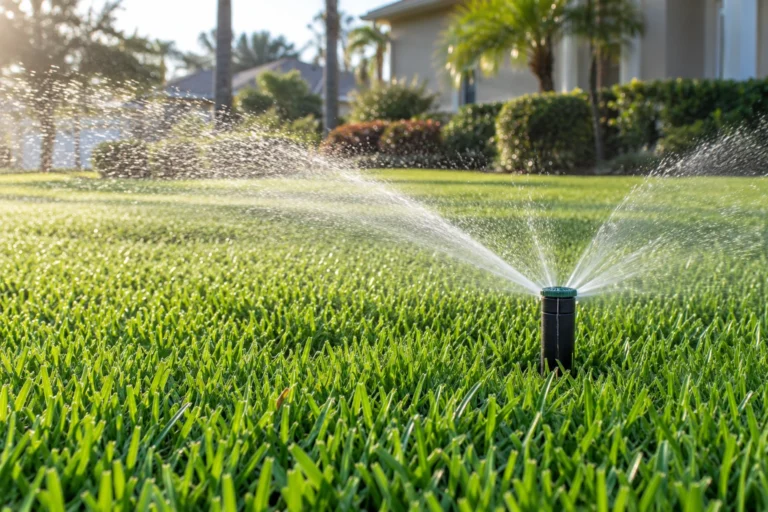
Adjust your irrigation timing. Water between 2 a.m. and 8 a.m. only. Never irrigate in the evening. This single change reduces the overnight leaf wetness that triggers gray leaf spot and large patch, and reduces prolonged soil saturation that favors take-all root rot.
Reduce nitrogen before and during disease-favorable conditions. Do not apply high-nitrogen fertilizer in late summer or during the rainy season if your lawn has a history of large patch or gray leaf spot. The lawn fertilization schedule for St. Augustine grass in North Florida is designed to work around these windows. Slow-release nitrogen sources are recommended by UF/IFAS because they reduce rapid flushes of lush growth.
Balance nitrogen with potassium. UF/IFAS (LH040) recommends that potassium applied should equal or exceed nitrogen, particularly in disease-prone areas. Potassium is readily leached from St. Johns County’s sandy soils, making this balance important to maintain.
Mow at the correct height. Floratam: 3.5–4 inches. Palmetto: 3–4 inches. Scalping stresses the turf and reduces its ability to resist pathogens. If a disease is active, UF/IFAS recommends raising the cutting height to increase green tissue for photosynthesis and recovery.
Avoid mowing wet grass in diseased areas. UF/IFAS recommends mowing diseased areas last and washing the mower after, to avoid spreading the pathogen to healthy parts of the lawn.
For take-all root rot specifically: get a soil test. UF/IFAS research notes that soil pH above 6.5 increases the severity of take-all root rot. If your lawn has a history of this disease returning in the same spot, a soil test from the UF/IFAS Extension office is worth doing before anything else.
UF/IFAS also notes that most disease outbreaks recur in the same location each year. Keeping a record — even a phone photo — of where and when damage appears each season gives you a reference point for prevention timing in future years.
When the Problem Needs Professional Diagnosis
Most fungal disease in established, well-managed home lawns corrects once cultural practices are adjusted. There are situations where professional diagnosis makes sense.
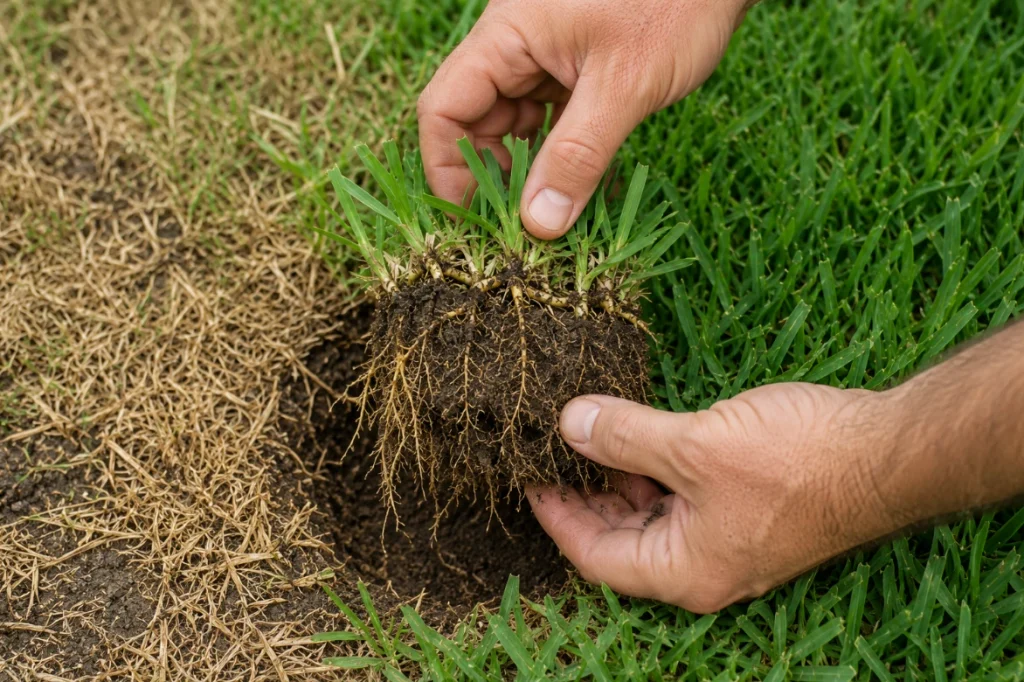
You cannot identify the disease from these descriptions. The UF/IFAS Plant Diagnostic Center accepts samples from Florida homeowners. Pull up an affected plug of turf, complete the submission form, and mail it in. This is the most reliable path to a confirmed diagnosis before spending money on fungicide.
Take-all root rot that keeps returning. If you have re-sodded an area more than once and the same patch keeps declining, a professional who can evaluate drainage, soil pH, and irrigation in that specific zone will give you more useful information than any article.
Damage that is spreading and not slowing. For gray leaf spot on newly established sod, or large patch that continues expanding during a sustained cool, wet stretch, preventive fungicide applied at the right timing may be appropriate. A licensed professional can confirm the disease, select the right product, and apply it correctly.
Frequently Asked Questions About St. Augustine Grass Lawn Disease
(In WordPress: add each question and answer below using the Rank Math FAQ block to enable FAQ schema. Do not paste these as plain text if you want schema — use the FAQ block.)
What does large patch look like on St. Augustine grass?
Large patch appears as roughly circular patches of discolored turf — 6 inches to several feet across — that turn yellow, then reddish-brown, then straw-colored. The key diagnostic detail is a dark, water-soaked rot where the grass blade meets the stolon at the base. An infected blade pulls away from the stolon with little resistance.
When does large patch appear in Florida?
Large patch is a cool-weather disease. It becomes active when nighttime temperatures drop below 80°F and is most aggressive in the 60–73°F range. In St. Johns County, that typically means October through November and again in February and March. It is suppressed during summer heat. Fall pre-emergent timing overlaps with this window — the St. Augustine Lawn Weed Calendar covers the fall weed management calendar for this same period.
What causes brown circular patches in St. Augustine grass?
The most common cause is large patch (Rhizoctonia solani). Other possible causes include chinch bug damage, drought stress, and mowing scalp — all of which produce brown or discolored areas. The key distinction with large patch is the cool-season timing and the rotting at the blade-sheath junction.
What is take-all root rot and how do I know if my lawn has it?
Take-all root rot (Gaeumannomyces graminis var. graminis) is a soil-borne fungal disease that attacks roots and stolons. The first visible sign is irregular yellowing during the summer rainy season. Confirmation requires pulling up a section of turf: blackened roots and stolon nodes, while leaf blades are yellowing above, are the diagnostic sign. There is no curative chemical treatment — management is cultural.
How do I tell gray leaf spot from large patch?
Gray leaf spot is active in summer (May–September) and produces oblong spots directly on individual grass blades — olive green to brown with a dark border, and a gray center in wet conditions. Large patch is active in cool weather (fall and spring) and causes yellowing in circular patches without blade-level spots. If you can see lesions on the blades themselves during summer, gray leaf spot is more likely.
Can I treat gray leaf spot myself?
In established, well-managed lawns, UF/IFAS states that gray leaf spot is usually not damaging enough to require fungicide. Adjusting irrigation to early morning and avoiding high-nitrogen applications during the rainy season resolves most cases. If fungicide is genuinely needed, propiconazole (found in products such as Ortho Lawn Disease Control) is labeled for homeowner use on residential lawns. Always read the full label before purchasing or applying. Chlorothalonil is no longer approved for use on residential turfgrass.
Do I need a fungicide for every lawn disease?
No. UF/IFAS states that management techniques should rely on cultural practices first, with fungicides applied only when necessary. Many cases of fungal disease in established home lawns resolve once irrigation timing, nitrogen levels, and mowing height are corrected. Applying a fungicide without correcting the cultural conditions that allowed the disease will not produce lasting results.
Where can I get a confirmed diagnosis for my lawn problem?
The UF/IFAS Plant Diagnostic Center at the University of Florida accepts samples from homeowners. Your local UF/IFAS Extension office — St. Johns County has an office in St. Augustine — can provide guidance on sample submission and result interpretation.
Sources
- UF/IFAS EDIS PP126 — Gray Leaf Spot of St. Augustinegrass: Cultural and Chemical Management Options: https://ask.ifas.ufl.edu/publication/PP126
- UF/IFAS EDIS LH040 — Turfgrass Disease Management: https://ask.ifas.ufl.edu/publication/LH040
- UF/IFAS EDIS LH010 — St. Augustinegrass for Florida Lawns: https://ask.ifas.ufl.edu/publication/LH010
- UF/IFAS Extension Pinellas County — Take-all Root Rot of St. Augustine Lawn: https://blogs.ifas.ufl.edu/pinellasco/2009/10/12/take-all-root-rot-of-st-augustine-lawn/
- UF/IFAS Extension Collier County — Brown Patch Disease of St. Augustinegrass