How to Water St. Augustine Grass in St. Johns County
Running your irrigation system on the same schedule every week, regardless of season, is one of the most common and damaging mistakes St. Augustine homeowners make in St. Johns County. UF/IFAS states this directly: not resetting the irrigation timer seasonally results in wasted water and poor plant health.
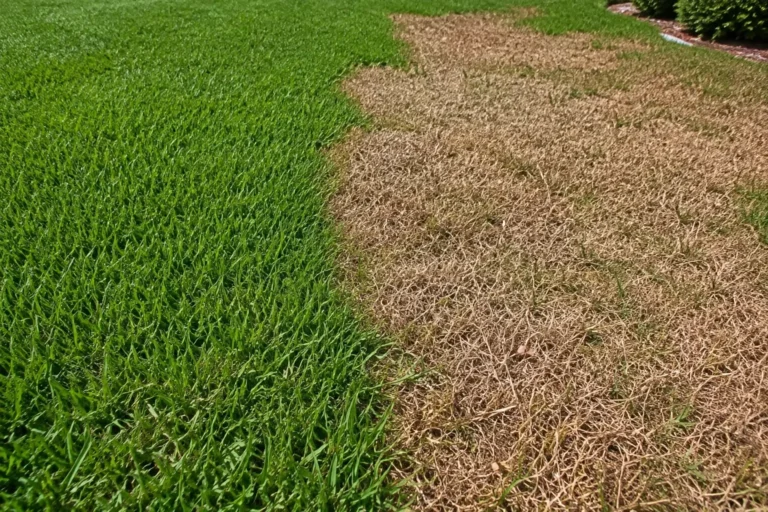
Overwatering and underwatering cause different problems — but both kill Floratam grass over time, and both are easy to confuse with pest or disease damage. This guide covers how much water St. Augustinegrass actually needs, what SJRWMD rules apply to St. Johns County addresses right now, how to adjust for each season, and how to read the signs that your current schedule is wrong.
How Much Water St. Augustine Grass Actually Needs
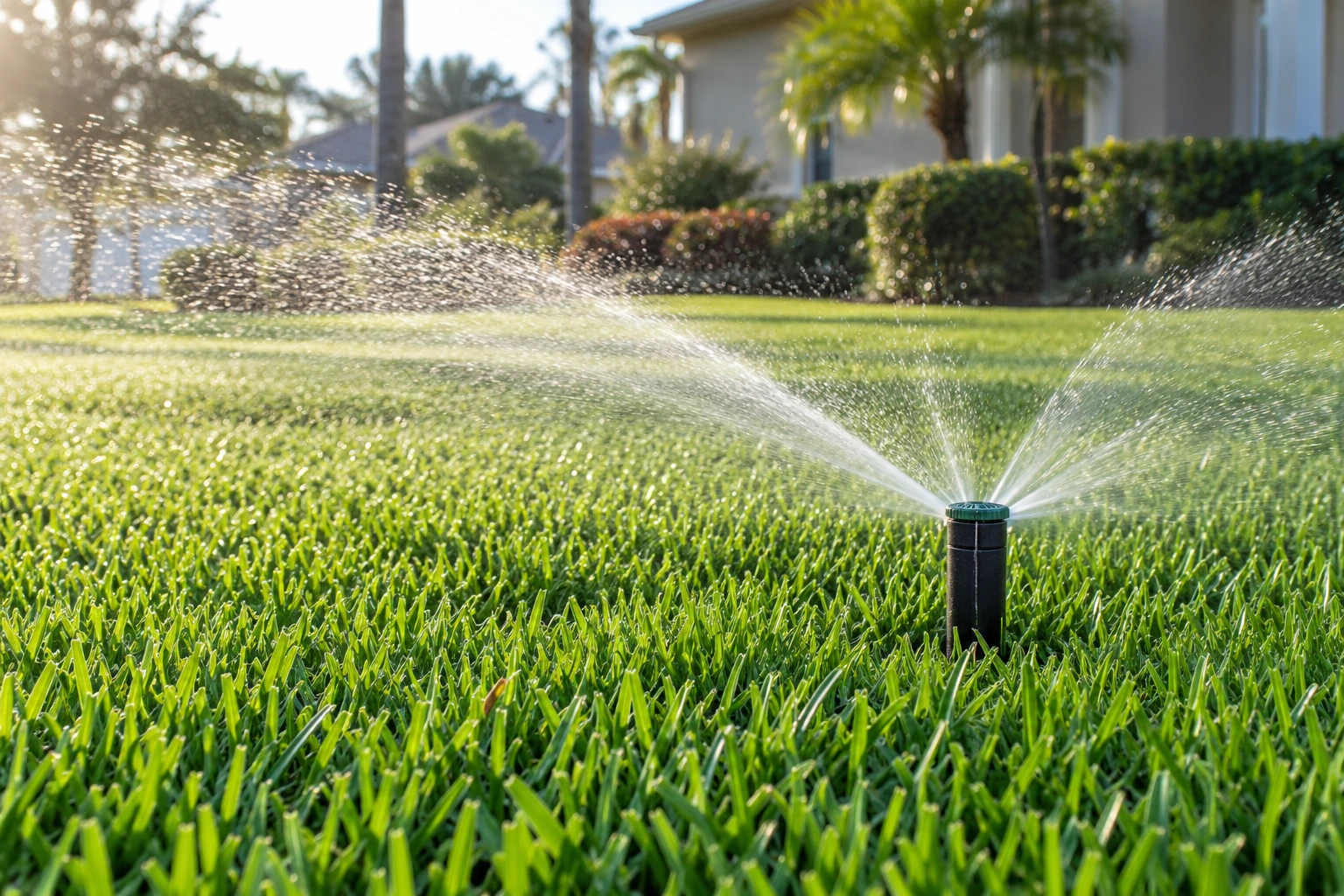
According to UF/IFAS (LH025), the goal of efficient irrigation is to wet only the turfgrass root zone without saturating the soil or causing runoff. The amount applied per watering session should stay consistent year-round. What changes is how often you water.
The target amount per zone: ½ to ¾ inch of water per irrigation session. UF/IFAS (EP110) notes that Florida’s sandy soils hold approximately 1 inch of water in the top 12 inches of soil. Since most St. Augustinegrass roots occupy the top 4–6 inches, ½ to ¾ inch of water wets that root zone and encourages roots to grow deeper — which is what you want.
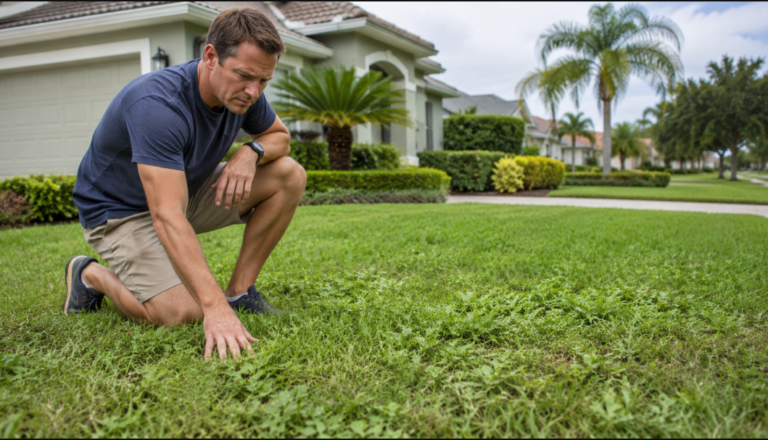
When to water: UF/IFAS calls for watering on an as-needed basis — not on a fixed daily or every-other-day schedule. The visual cues that tell you the lawn needs water are: leaf blades folded lengthwise, a blue-gray color replacing the normal green, and visible footprints or tire tracks that remain long after they are made.
What to avoid: Light, frequent watering of mature turf is inefficient and encourages shallow root systems, per UF/IFAS. Running irrigation for 5–10 minutes every day never wets the root zone adequately and keeps the soil surface constantly moist — conditions that favor fungal disease. Excessive irrigation that keeps roots saturated is equally harmful.
SJRWMD Irrigation Restrictions for St. Johns County
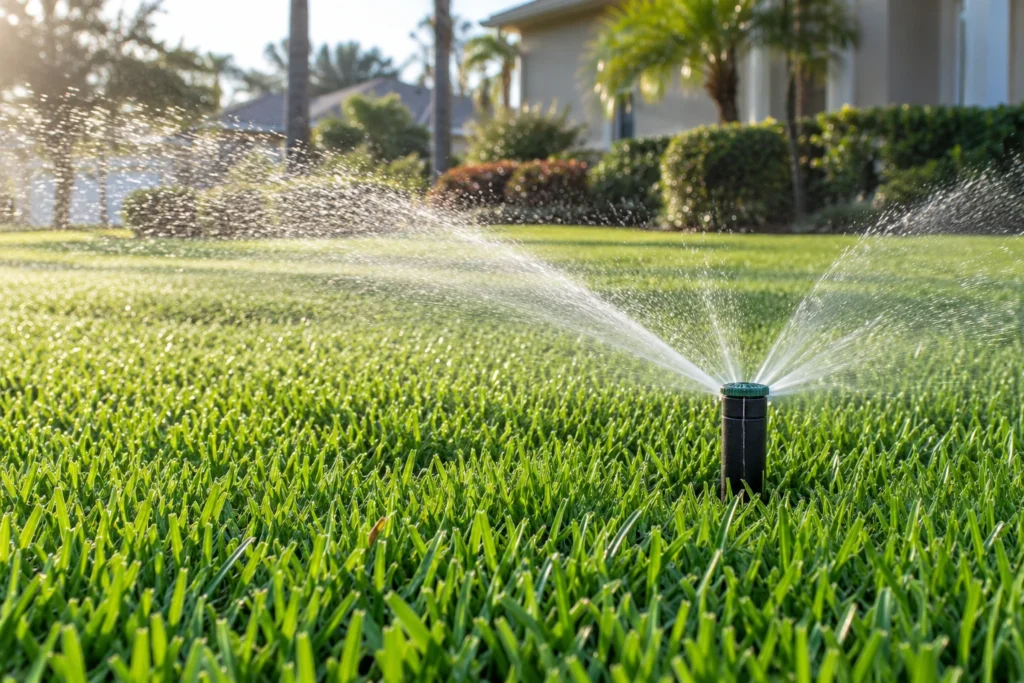
All landscape irrigation in St. Johns County falls under the St. Johns River Water Management District (SJRWMD) mandatory watering restrictions. These rules apply whether your system runs on potable water, a private well, or ground or surface water. They apply to homes, rental properties, and HOA common areas alike.
Standard Schedule (When No Water Shortage Is Active)
During Daylight Saving Time (second Sunday in March through first Sunday in November), residential irrigation is allowed on two days per week:
Odd-numbered addresses (ending in 1, 3, 5, 7, or 9): Wednesday and Saturday
Even-numbered addresses (ending in 0, 2, 4, 6, or 8): Thursday and Sunday
During Eastern Standard Time (first Sunday in November through second Sunday in March), the schedule drops to one day per week:
Odd-numbered addresses: Saturday only
Even-numbered addresses: Sunday only
Year-round time restriction: No irrigation between 10 a.m. and 4 p.m., regardless of day.
Per-zone limits: No more than ¾ inch of water and no more than one hour per zone per irrigation day.
If a Water Shortage Declaration Is Active
SJRWMD issues Water Shortage Declarations — Phase I through Phase IV — during extended drought conditions. Under a Phase III or Phase IV declaration, irrigation may be further restricted to fewer days per week, with tighter time-of-day windows. Restrictions change as conditions change.
Always check the current SJRWMD schedule directly before setting your timer: sjrwmd.com/wateringrestrictions
Do not rely on a neighbor’s schedule, a lawn care company’s assumption, or what was posted on a community board last season. The SJRWMD site updates when restrictions change.
Nocatee and SilverLeaf Reclaimed Water Schedules
Homes in Nocatee using JEA reclaimed water follow a four-zone schedule based on their subdivision and address. Days and times are assigned per zone and may differ from the standard odd/even schedule — though the number of allowed irrigation days per week still follows SJRWMD guidelines.
Homes in SilverLeaf using St. Johns County Utilities reclaimed water follow a separate subdivision-based schedule.
If your home uses reclaimed water, check with your utility provider for your specific schedule. Under an active water shortage declaration, reclaimed water schedules may also be reduced.
New Sod Exception
If you have just installed sod, SJRWMD allows a temporary establishment schedule. Under standard conditions: any day for the first 30 days, then every other day for the next 30 days. Check sjrwmd.com for the current establishment schedule if a shortage declaration is active, as the allowances change.
Seasonal Watering Adjustments for North Florida
UF/IFAS (LH025) is clear that irrigation frequency must be reset seasonally. A timer set for July conditions left unchanged through November will overwater the lawn during the cooler, slower-growing months and increase disease pressure.
Summer (June–September)
This is the rainy season in St. Johns County. Afternoon thunderstorms deliver significant rainfall most days. UF/IFAS recommends turning irrigation off entirely during periods of adequate rainfall and allowing the rain to meet the lawn’s needs. Run your system only when the stress signals appear — folded blades, blue-gray color, visible footprints.
This is also when gray leaf spot and take-all root rot are most active. Evening irrigation during summer months extends leaf wetness overnight and feeds these diseases. UF/IFAS recommends running irrigation only between 2 a.m. and 8 a.m. to allow turf to dry quickly after sunrise. If a fungal disease is present or has been a recurring problem, this timing adjustment alone is one of the most effective cultural controls available. For more on how overwatering contributes to fungal problems, see our lawn disease guide for St. Augustine grass.
Fall (October–November)
Rainfall drops, temperatures begin to moderate, and Floratam slows its growth rate. Irrigation frequency should decrease from the summer schedule. Nighttime temperatures dropping into the 60s create conditions favorable for large patch disease — evening irrigation that keeps blades wet through cool nights increases the risk. Shift watering to early morning and reduce zone run times.
Winter (December–February)
St. Augustinegrass in North Florida reduces water uptake significantly during cool months. UF/IFAS data on irrigation frequency for Gainesville — the closest climate reference for St. Johns County — shows that established turf with 6-inch roots can go 7–23 days between irrigation events in winter, assuming no rainfall. Most lawns in St. Johns County receive enough winter rainfall that supplemental irrigation is rarely needed. SJRWMD reduces the standard schedule to one day per week during Eastern Standard Time for this reason.
If your system is set to run twice a week through December and January, you are likely overwatering.
Spring (March–May)
Growth resumes as temperatures rise and the pre-rainy-season dry period typically arrives. Spring is when supplemental irrigation is most needed in St. Johns County — the period before consistent summer rainfall begins, often March through May. Increase frequency as temperatures climb and watch for drought stress signs. This is also when chinch bugs begin to re-establish from the previous season’s feeding areas. Drought-stressed turf and chinch bug damage look nearly identical — see our guide to lawn pest problems in St. Augustine if you are not sure which problem you have.
Signs You Are Overwatering
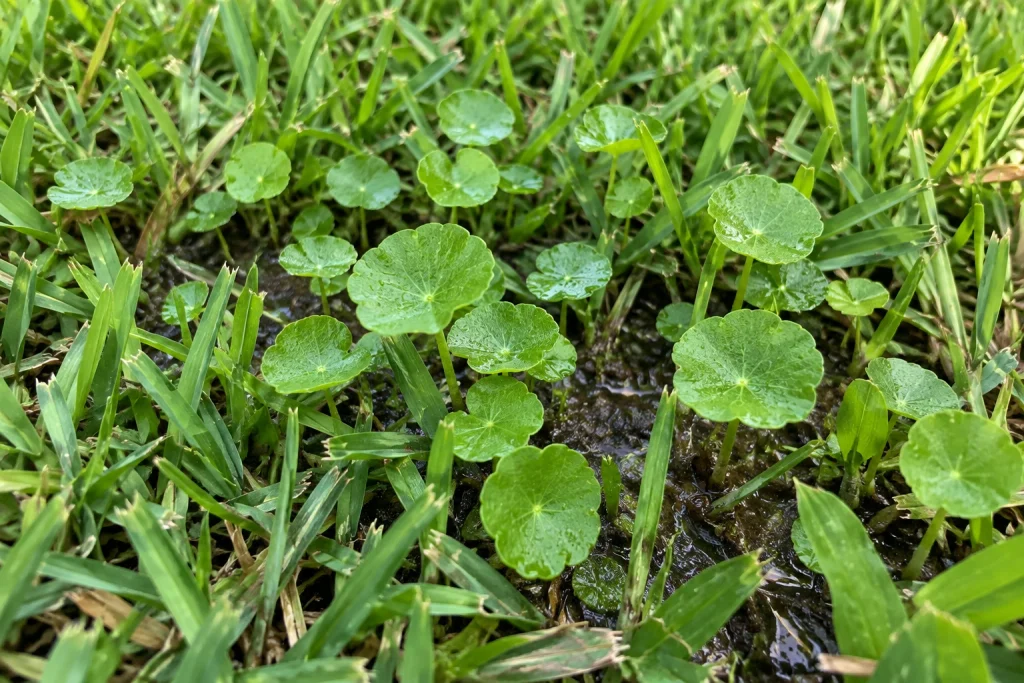
Overwatering is more common than underwatering in St. Johns County, partly because homeowners set timers during establishment and never adjust them, and partly because reclaimed water availability makes running irrigation feel cost-free.
Fungal disease. Gray leaf spot, large patch, and take-all root rot are all triggered or worsened by excess moisture. If your lawn develops circular brown patches in fall, irregular yellowing in summer, or blade-level spots during rainy season, overwatering may be a contributing factor before anything else.
Dollar weed and sedges. UF/IFAS (LH025) states directly that overwatering promotes the growth of dollar weed and sedges. If these weeds appear in the same areas repeatedly, persistently wet soil is worth investigating as a cause. The St. Augustine Lawn Weed Calendar covers identification and timing for both species.
Shallow root system. Turf that is watered frequently but lightly never develops deep roots. The grass looks fine until a brief dry period arrives — then it declines rapidly because roots cannot reach moisture below the surface. This pattern is common in lawns on fixed daily schedules.
Runoff. Water flowing off the turf and onto driveways, sidewalks, or the street before the zone finishes running means the application rate exceeds the soil’s infiltration rate. On sandy soils this is less common than on clay, but it can happen in compacted or thatch-heavy areas. SJRWMD rules prohibit irrigation that results in runoff.
Signs You Are Underwatering and What to Check First
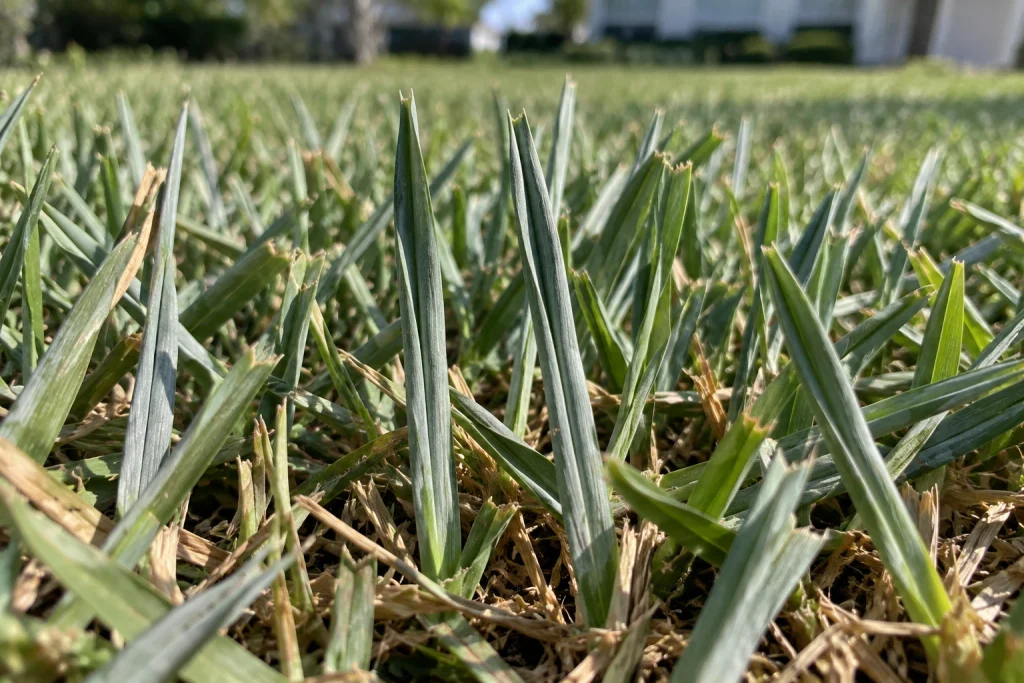
Curled or folded blades. UF/IFAS identifies this as the primary visual indicator that St. Augustinegrass needs water. Floratam blades fold lengthwise — almost in half — when the plant is under drought stress. This is the time to irrigate, not before.
Blue-gray color. Healthy Floratam is green to blue-green. A dull blue-gray cast, particularly in sunny areas, indicates moisture stress.
Footprints that stay. Press your foot into the lawn. If the impression remains visible for more than a minute, the grass does not have enough moisture to spring back. Walk across the lawn at midday — if you can see your footprints across the yard, irrigation is needed.
Damage that looks like chinch bugs. Drought stress and chinch bug damage both produce yellowing that begins in the hottest, sunniest part of the lawn — often near a driveway or sidewalk. Before treating for chinch bugs, confirm the cause. Our lawn pest problems in St. Augustine guide covers the flotation test you can do in five minutes to confirm whether chinch bugs are present.
How to Calibrate Your Irrigation System
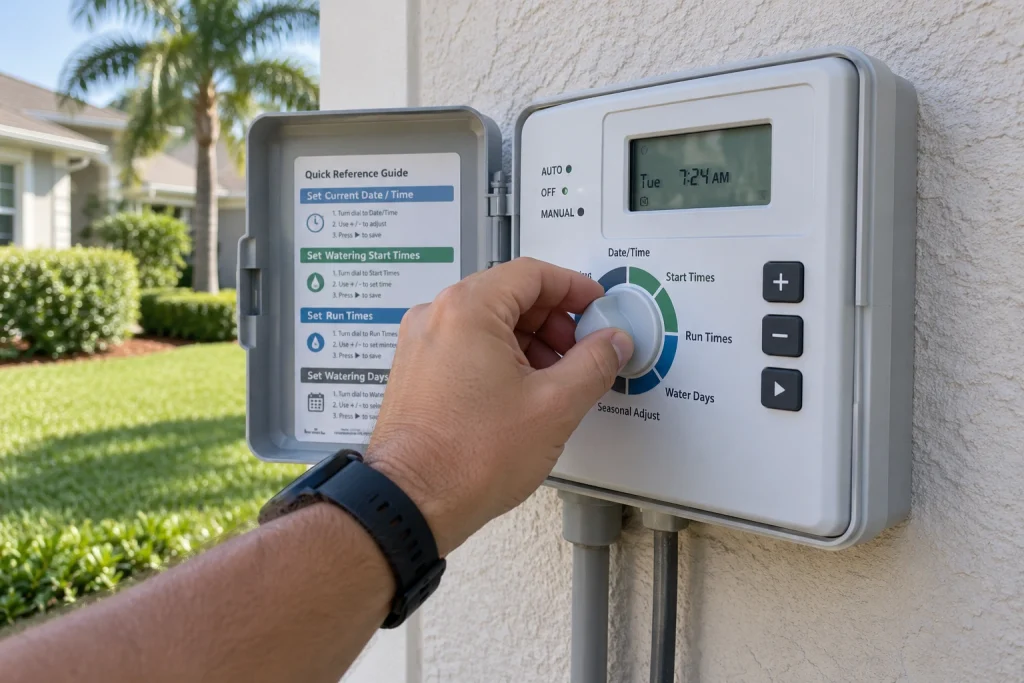
Knowing that you should apply ½ to ¾ inch per zone is only useful if you know how long your system needs to run to deliver that amount. Most homeowners do not know their system’s output rate.
The catch-can test is the simplest way to measure it. Place several straight-sided containers — tuna cans work well — in one zone and run that zone for 15 minutes. Measure the water depth in each can. Multiply by four to get the hourly output. If you find that your rotors deliver ½ inch in 30 minutes, run each zone for 30 minutes on your scheduled days.
Heads closer to the supply line typically deliver more than heads at the far end. If you see dry spots at the outer edges of a zone but healthy turf at the center, coverage overlap may be inadequate or a head may be tilted or clogged.
Rain sensor check. SJRWMD rules require that automatic irrigation systems installed after May 1991 include a working rain sensor that overrides the system after adequate rainfall. If your system runs the day after a significant rainstorm, the sensor is not functioning. A working sensor is one of the most practical water-saving tools available — it also keeps you in compliance with SJRWMD rules.
Seasonal timer reset. After completing the catch-can test, set your controller to water only on your allowed days and for the run time that delivers ½ to ¾ inch per zone. Then revisit the timer at the start of each season. UF/IFAS is explicit: leaving the timer at a fixed schedule year-round produces poor plant health and water waste.
Frequently Asked Questions About Watering St. Augustine Grass in St. Johns County
How many days a week can I water my lawn in St. Johns County?
Under the standard SJRWMD schedule during Daylight Saving Time, residential properties are allowed two days per week. During Eastern Standard Time, one day per week. If a Water Shortage Declaration is active, restrictions may be reduced further. Check sjrwmd.com/wateringrestrictions for the current schedule before setting your timer.
What days can I water my lawn based on my address?
Under the standard schedule: odd-numbered addresses (ending in 1, 3, 5, 7, or 9) water on Wednesday and Saturday during DST, and Saturday only during EST. Even-numbered addresses (ending in 0, 2, 4, 6, or 8) water on Thursday and Sunday during DST, and Sunday only during EST. These days may change under a shortage declaration.
What time of day should I water St. Augustine grass in Florida?
SJRWMD prohibits irrigation between 10 a.m. and 4 p.m. year-round. UF/IFAS recommends watering between 2 a.m. and 8 a.m. — when dew is already present, the grass dries quickly after sunrise, and disease pressure from overnight leaf wetness is minimized.
How much water does St. Augustine grass need per watering?
UF/IFAS recommends applying ½ to ¾ inch of water per irrigation session. This wets the top 4–6 inches of the root zone on Florida’s sandy soils without saturating it. The catch-can test is the most reliable way to determine how long your system needs to run to deliver that amount.
Is my Nocatee lawn on the same SJRWMD schedule?
Nocatee homes using JEA reclaimed water follow a zone-based schedule assigned by subdivision. The number of allowed days per week follows SJRWMD guidelines, but your specific days and times may differ from the odd/even residential schedule. Check jea.com or your JEA account for your assigned schedule. Under an active water shortage declaration, Nocatee reclaimed water is also subject to restrictions.
Why does my lawn look stressed even though I water on schedule?
Several possibilities. On sandy St. Johns County soils, scheduled irrigation without a rain sensor may be running after adequate rainfall, keeping the root zone saturated and limiting oxygen to the roots. Alternatively, the schedule may not deliver enough per zone — check your run times against the ½ to ¾ inch target. Drought stress and chinch bug damage look nearly the same. If adjusting your irrigation does not resolve the problem within a week, see our lawn pest problems in St. Augustine guide to rule out an active pest infestation.
Does overwatering cause weeds in St. Augustine grass?
Yes. UF/IFAS states that overwatering promotes the growth of dollar weed and sedges. Both species thrive in consistently wet soil and will colonize thin or stressed areas of Floratam quickly. Correcting irrigation is a necessary first step before weed treatment is effective. The St. Augustine Lawn Weed Calendar covers identification and seasonal treatment timing for both species.
Should I water my St. Augustine grass in winter?
In North Florida, established St. Augustinegrass requires minimal supplemental irrigation in winter. UF/IFAS data shows that turf with 6-inch roots can go 7–23 days between irrigation events in winter without rainfall. Most St. Johns County lawns receive adequate winter rainfall. SJRWMD reduces the standard schedule to one day per week during Eastern Standard Time to reflect this. If you see drought stress signs in winter — folded blades, blue-gray color — water. Otherwise, let the grass rest.
Sources
- UF/IFAS EDIS LH025 — Watering Your Florida Lawn: https://ask.ifas.ufl.edu/publication/LH025
- UF/IFAS EDIS EP110 — Fertilization and Irrigation Needs for Florida Lawns and Landscapes: https://ask.ifas.ufl.edu/publication/EP110
- UF/IFAS EDIS LH010 — St. Augustinegrass for Florida Lawns: https://ask.ifas.ufl.edu/publication/LH010
- SJRWMD Watering Restrictions (current): https://www.sjrwmd.com/wateringrestrictions/
- St. Johns County Water Conservation: https://www.sjcfl.us/water-conservation/